

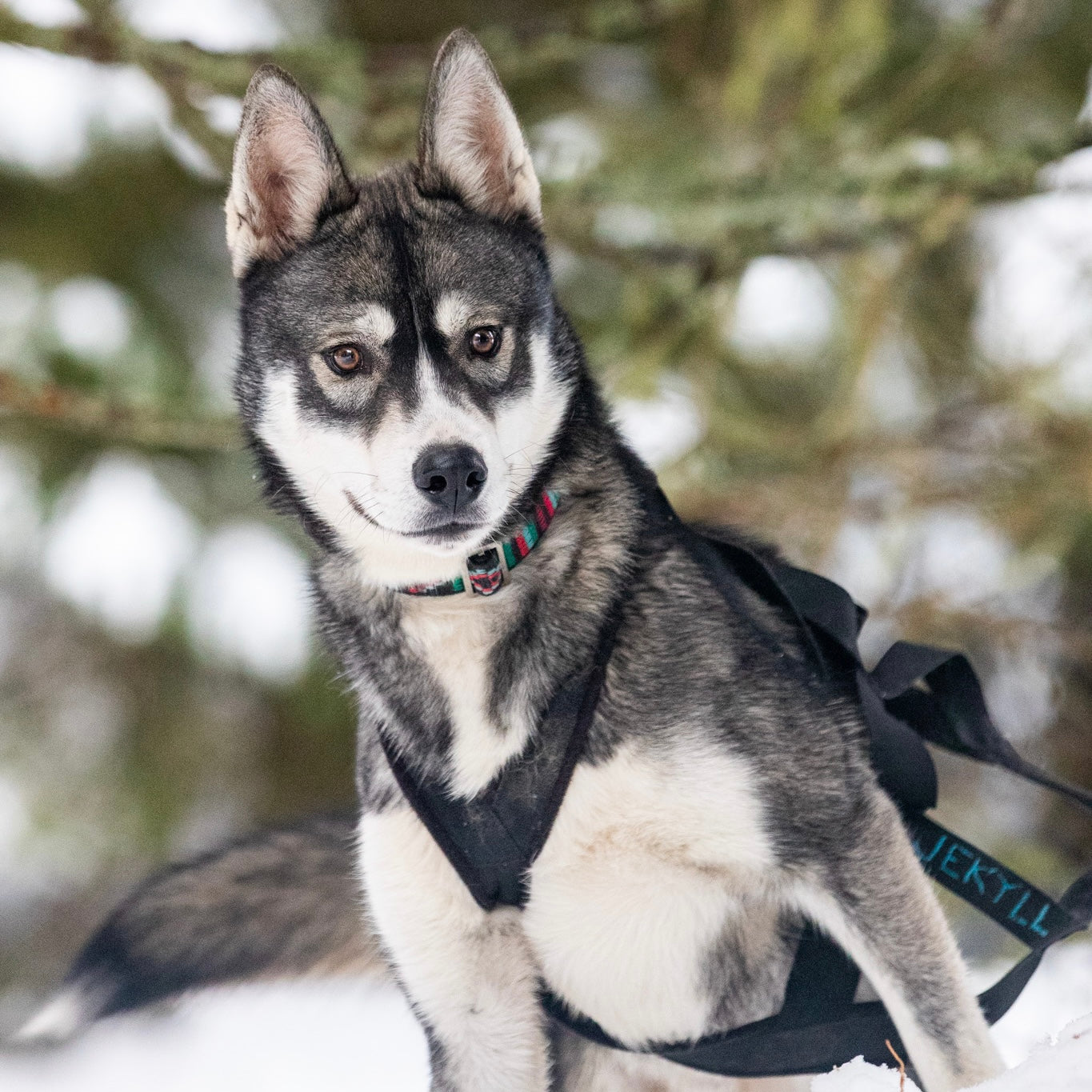
From survival to a competitive sport
With the arrival of snowmobiles and roads, sled dogs could have disappeared from the northern landscapes. Yet, it transformed. What was an essential mode of transport became a demanding sport.
Today, mushing comes in different forms: sprint races, mid-distance, long-distance, but also canicross, bikejoring, or ski-joëring. The essence remains the same: an alliance between human and dog.
Despite the challenges posed by climate change and the evolution of winter sports, the practice continues to attract. Why? Because it embodies something rare in our modern world: a return to basics.
Mushing is captivating, enchanting, almost magnetic. It attracts because it tells a story greater than performance: that of connection.
A team, a living organization
What is deeply intriguing about mushing is that it is not a human "pulled" by their dogs. It is a true team effort, finely orchestrated.
A team is precisely structured:
• Lead dogs: positioned at the very front, they are the decision-makers on the terrain. They listen to the musher's commands (right, left, stop), but they also analyze obstacles, evaluate snow quality, and detect invisible dangers.
• Swing dogs: just behind the leaders, they support changes in direction and stabilize turns.
• Team dogs: in the center, they provide consistent power, endurance, and pace.
• Wheel dogs: positioned near the sled, these are often the physically strongest. They bear the weight and ensure starts.
Each dog has a personality, a temperament, a specific skill. Some are strategic, others are motors, and others still are reassuring for the group.
The musher, for their part, is a guide. They observe, anticipate, support, brake, and encourage. They make strategic decisions, but they also trust the instinct of their dogs. They do not merely endure the movement: they build it with them.
In the business world, we often talk about participatory leadership. Mushing is a concrete metaphor for this. The leader sets the direction, but knows how to listen to their team. They understand that collective performance rests on the complementarity of talents.
Nala and Valérie: when instinct takes the lead
Valérie, founder of Element Vet, has always lived in the Alps, near Grenoble. The mountains are not a recent choice: they are her cradle. She grew up respecting the peaks, forests, and natural cycles. This intimate relationship with her environment shaped her vision of mushing.
Among her dogs, Nala held a special place. A lead dog, she was not only fast. She was clear-sighted, attentive, almost strategic.
One winter day, during high-altitude training, a sudden blizzard arose. In minutes, visibility dropped. The wind erased the tracks behind the sled. The cold became biting.
Valérie ordered to go straight, towards a passage she knew well. But Nala slowed down. She gently pulled on the line to the left, refusing the usual trajectory. In these moments, ego has no place. Valérie trusted.
A few meters further, the snow proved unstable. A snowdrift concealed a small ravine formed by the wind. If the team had followed the initial route, the sled could have overturned. By bypassing the obstacle, Nala had undoubtedly prevented a dangerous fall for the entire team.
That day, the decision did not come from the human. It came from the dog.
This is why mushing remains so fascinating: it reminds us that intelligence is not an exclusively human trait. In certain extreme situations, animal instinct perceives what our sight no longer sees.
A legend perpetuated by culture
Mushing continues to fuel the collective imagination through books and cinema.
The novel The Call of the Wild by Jack London made generations of readers by recounting the transformation of a dog confronted with the harshness of the Great North.
In cinema, the film Antarctica (original title: Eight Below) deeply touched the public by highlighting the loyalty and resilience of abandoned dogs in Antarctica.
These works have contributed to mythologizing the sled dog. But behind the myth, there is a reality: that of authentic cooperation.
ELEMENT VET: born from the field, rooted in the Alps
It was in this demanding environment that ELEMENT VET was born.
Through intense competitions and training, Valérie noticed a gap. The available food supplements did not fully meet the specific needs of her dogs: muscle recovery, joint support, strengthened immunity, digestion adapted to exertion.
Rather than resigning herself, she decided to create her own brand.
True to her Alpine upbringing and her deep attachment to her native mountains, she made a clear choice: to produce locally. All phytotherapy and formulations are developed and manufactured near Grenoble, in the heart of her territory.
This local anchoring is no coincidence. It guarantees the quality, traceability, and coherence of the products. It reduces the environmental footprint by limiting transport. And above all, it employs local stakeholders: partners, suppliers, local laboratories.
"Made in France" is not just an argument here. It is a responsibility. A way to align the company with the values of mushing: respect, trust, solidarity.
As in a team, every link counts.
At ELEMENT VET, the dog is never considered a performance tool. It is a partner. An athlete. A sensitive and intelligent being. Decisions are made by listening to and understanding the real needs of the animal.
Why does mushing still attract us?
In a world saturated with technology and instantaneity, mushing offers something else: the silence of the snow, the synchronized breath of the dogs, the crunch of the sled on the ice.
It highlights simple but powerful values:
-
Trust, between the musher and their dogs.
-
Resilience, when snow, wind, or fatigue test the team.
-
Cooperation, even among competitors.
-
Humility, when facing the elements.
-
Listening to living beings.
It shows that one can aim for performance without sacrificing respect. That a leader can lead without dominating. That a team can go further when it functions as a single organism.
Perhaps it is this, ultimately, that captivates us: mushing reminds us that the alliance between humans and dogs is one of the oldest in our history. An alliance that, even in the digital age and facing climate challenges, continues to inspire.
A rare equality in the world of sport
Mushing has a unique characteristic that is still too little known: men and women compete in the same categories, without distinction of gender.
On the starting line, there is no women's or men's ranking. There is only a team, a musher, a crew. The only regulatory difference concerns the number of dogs entered depending on the category (sprint, mid-distance, long-distance). Performance depends neither on gender nor on brute physical strength alone. It relies on strategy, effort management, terrain reading, and the ability to understand and guide one's dogs.
In this sport, authority is not imposed: it is built through relationship.
This natural equality reflects the very essence of mushing: it is not a demonstration of domination, but a demonstration of harmony. Success belongs to whoever knows how to listen, anticipate, and cooperate.
A modern lesson in an ancestral world.
When competition gives way to mutual aid
During a particularly harsh night race, swept by violent winds and unstable snow, Valérie Maumon found herself in a critical situation. In the darkness, her sled overturned in a barely visible ravine. It was impossible to get it out alone. The dogs, still harnessed, awaited instructions in the biting cold.
In many sports, every second counts. Stopping means losing. Helping means giving up an advantage.
Yet, that night, a competitor—a man entered in the same race—braked his team and came back to help her.
Together, they freed the sled, secured the dogs, and restored the trajectory.
But the story doesn't end there.
The dogs of this musher, disturbed by the storm and agitation, became nervous. Tension mounted in the lines. Valérie, with a gentle and calm voice, approached. She spoke calmly. She breathed slowly. Gradually, the dogs calmed down, regaining their focus despite the extreme conditions.
In that ravine, in the heart of the night, there were no more adversaries. There was only a community facing nature.
Mushing reminds us that competition should never erase the essential: solidarity.
The values that still captivate us
If mushing continues to fascinate, it is perhaps because it highlights values that our era is seeking to rediscover:
-
Equality, where women and men share the same starting line.
-
Trust, between the musher and their dogs.
-
Humility, when facing the elements.
-
Resilience, when snow, wind, or fatigue put the team to the test.
-
Cooperation, even among competitors.
-
Respect for living beings, at the heart of every decision.
In a team, no one moves forward alone.
In a race, no one is totally isolated.
In the storm, we stand together.
Perhaps this is what, ultimately, makes mushing timeless.
It doesn't just celebrate speed or performance.
It celebrates connection.
And as long as this bond exists—between humans, between dogs, between competitors—mushing will continue to captivate us.
And you, sled dogs, do you find this as fascinating as we do?


