

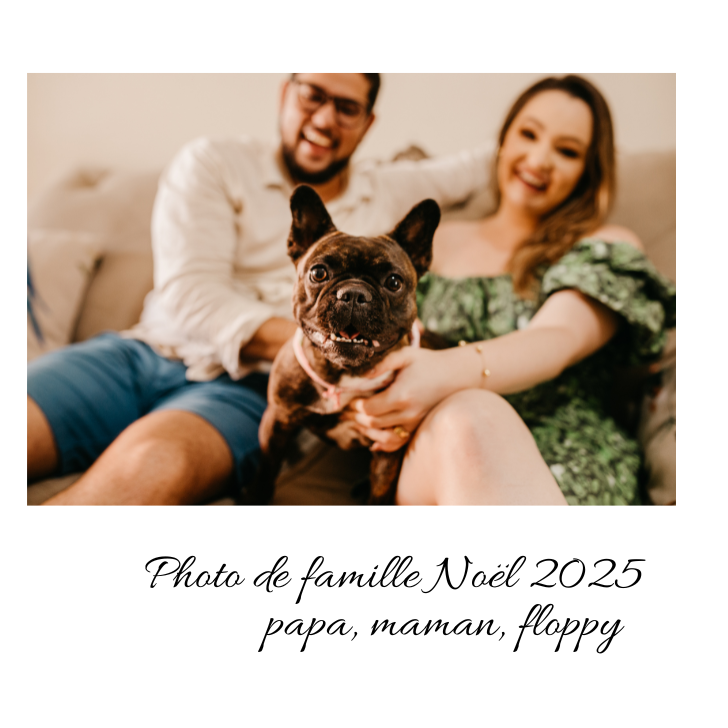
Dog parents: why our dogs have become family members (and what that says about our society)
In recent years, an expression has slowly become part of our daily lives: that of dog parents. Long confined to Anglo-Saxon culture, the term has become established in France almost without us realizing it. We no longer speak of "master," we speak of "dog parent." We no longer say "my animal," but "my baby," "my family member." This shift in vocabulary is not insignificant. It says something profound about how our relationship with living beings, affection, and family is evolving.
Dogs are no longer just pets, much less utilitarian animals. They have become emotional companions, sometimes even an emotional pillar. In a context where life paths are transforming, where people couple up later, where parenthood is often postponed, sometimes even questioned, dogs occupy a new place. They become a constant presence, an emotional anchor, a source of stability. This phenomenon has intensified in recent years, particularly after lockdowns, a period during which many rediscovered the value of a non-human but deeply reassuring bond.
Behind this evolution lies a real societal question: what does dog parenting say about our relationship to love, family, and responsibility? Is it a healthy evolution of our relationship with living beings, or a way to fill emotional gaps in a society where human connections are becoming fragile?
When one adopts a dog while living alone, it often happens that the dog takes a central place in daily life. It structures the days, imposes routines, forces one to go out, to be anchored in the present. For some people, the dog becomes the first living being for whom they feel fully responsible. When a romantic relationship comes later, it is not simply about welcoming a new human into one's life, but about composing a trio. There is the couple, and there is the dog. The partner does not just meet a person, but an already existing relationship. This configuration can be a source of very beautiful co-construction dynamics, but it can also generate tensions. What place do we give to the animal in the couple's balance? To what extent is each person willing to adapt to the dog's presence in the intimacy of the home, in the organization of holidays, in daily life?
In some life paths, the dog can also be seen as a step. For some, it represents a first experience of emotional responsibility before the arrival of human children. For others, it becomes a life choice in its own right, a form of assumed parenthood without the desire for a child. The question of whether a dog can "replace" a child is often asked in an overly simplistic way. A dog does not replace a child. Relationships are not comparable, nor are needs, projections, or responsibilities. But this debate sheds light on something deeper: our need for connection, care, commitment, and sustained presence. Dog parenting speaks less of substitution than of the transformation of how we attach and care.
This phenomenon also questions our tendency towards anthropomorphism. By constantly projecting our human emotions onto our dogs, aren't we at risk of forgetting that they are, first and foremost, dogs, with their own needs, their own limits, their own language? Wanting to offer them a more comfortable, more respectful, more attentive life is a positive evolution. But considering them as miniature humans can sometimes distance us from their real needs. Respect for the dog also involves respecting its nature, its instincts, its rhythm, its body.
Looking at what is happening elsewhere in the world allows us to gain perspective on our own practices. In the United States, the concept of pet parenting has been fully embraced for a long time. Dogs are integrated into living spaces, workplaces, holidays, and an entire industry has developed around their well-being. In Japan, in a context of high urban density and social solitude, the humanization of dogs is very marked. They sometimes become central life companions in daily lives where human relationships are rarer. In Hawaii, in certain cultural traditions, one does not define oneself as the owner of one's dog, but rather as its guardian. The animal is not possessed; it is accompanied. This vision invites us to rethink the human-animal relationship as a respectful cohabitation rather than a relationship of domination.
In France, we are at a moment of transition. The word "master" is increasingly being questioned, and terms like "guardian" or "human of reference" are emerging. Language evolves because perspective changes. This evolution can be seen as progress in recognizing animal welfare, but it also invites a form of lucidity. Deeply loving one's dog should never mean forgetting that it needs to be treated as a dog, with all that implies respecting its physical, mental, and emotional needs.
At ELEMENT VET, this vision is at the heart of our commitment. For us, dogs are full-fledged family members. It's hard to imagine our lives without them. Valérie Maumon, founder of ELEMENT VET, herself shares her daily life with nine Siberian Huskies. Being a "dog mom" is not a marketing slogan; it's a lived reality, with all the joy, constraints, responsibilities, and daily attention that it entails. Taking care of your dog's health is, in our opinion, the first form of true love you can offer them. Well-being is not limited to affection or moments of complicity. It involves prevention, listening to body signals, supporting aging, and paying attention to the animal's energy, digestion, joints, and overall balance.

But well-being is also built in these simple moments of daily life. Taking the time to massage a tired dog after a long walk, checking its paw pads after an outing on difficult terrain, sitting on the ground to be at its height, observing its signs of fatigue or excitement – these are all gestures that tell of a more conscious relationship. These moments of presence say a lot about the place dogs occupy in our lives today. They are no longer "alongside" our daily lives; they are fully a part of them.
Ultimately, dog parenting raises a simple yet essential question: what place do we want to give to living beings in our modern lives? Are we trying to fill gaps, or to build more conscious, more respectful, more engaged relationships, even when they are not human? Loving your dog as a family member can be a magnificent evolution of our relationship with living beings, provided we do not forget what they truly are. Respecting them also means accepting that they are neither a child nor a human, but a dog, with all the richness that implies.
At ELEMENT VET, we believe that taking care of the health and well-being of our dogs means giving them the place they deserve in our lives: that of beloved, respected, and consciously accompanied living beings.
And you, where do you stand in this debate?
Do you recognize yourself in the term "dog parent"?
Is your dog your "baby," or are you uncomfortable with this expression while still considering them a full member of your family?
Do you still consider yourself the "master" of your dog, or rather their guardian, their human of reference, their travel companion?
This phenomenon has become a real societal question, a turning point in our daily lives in recent years, and we are genuinely interested in your perspective.
Come and discuss with us on our social networks, share your vision, your feelings, your agreements as well as your disagreements.
Your opinion matters to us, and we are very eager to know where you stand.


