

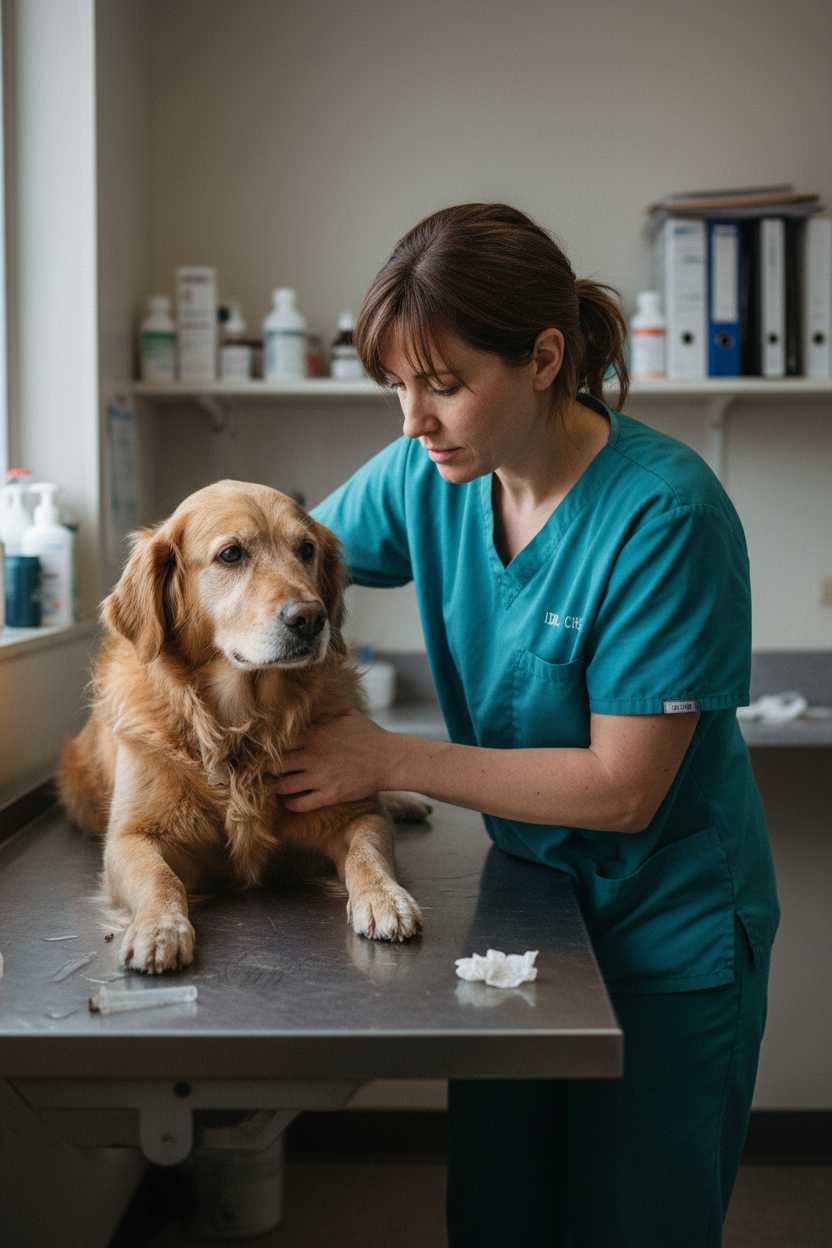
Long reserved for humans, osteopathy has gradually established itself as an essential complementary approach in animal health, and in dogs in particular. Today, more and more owners turn to this gentle practice to improve their dog's well-being, to head off certain aches, or to support recovery. But one question comes up again and again: when should you consult an osteopath for your dog? And above all, which signs should alert you?

Understanding canine osteopathy
Canine osteopathy rests on a whole-body approach. The discipline considers that every structure – muscles, joints, ligaments, organs – is interconnected. An imbalance in one place can therefore lead to compensations elsewhere, sometimes invisible to the naked eye. The aim is to restore mobility to the tissues, re-establish balance, and allow the body to regulate itself naturally. Contrary to some received ideas, osteopathy is not only for injured or sick dogs. It works just as well in prevention as in support, whether your dog is sporting, sedentary, young or old.
The signs that should alert you
A dog does not speak, but he communicates a great deal through his behaviour and his posture. Certain signals, sometimes discreet, can indicate that an imbalance is setting in. For instance, if your dog suddenly becomes less active, hesitates to jump or climb stairs, or seems stiff on getting up, that may reflect joint discomfort. You may also notice changes in behaviour: irritability, unusual tiredness, less enthusiasm on walks. Other, subtler signs exist: a dog who licks one area excessively, who always turns the same way, or who adopts an asymmetrical posture standing or lying down. These small details, often overlooked, are valuable indicators. In all these cases, consulting an osteopath helps identify the origin of the problem before it worsens.

Sporting dogs: particular attention
Dogs taking part in a sport – agility, canicross, obedience, hunting – place intense demands on their bodies. As with a human athlete, repeated strain can lead to micro-injuries, muscular tension or imbalances. In these dogs, osteopathy plays a key role, both in prevention and in recovery. A consultation is advisable after a competition, if performance drops, or if you notice a change in stride or drive. Even without injury, regular follow-up is recommended. On average, two to three sessions a year help maintain good mobility and prevent compensations from setting in. Massage gel (In this context, a few simple habits can be built into daily life. A light massage with our Arnica and Essential Oils Dog Massage Gel – ELEMENT VET) after exercise, for example, supports muscle recovery and limits tension. Using a suitable massage gel can bring real comfort, alongside the osteopath's work, particularly to prepare or relax the tissues.

Older dogs: supporting ageing
With age, joints become less supple, muscles lose tone, and discomfort can appear gradually. Osteopathy is particularly helpful for senior dogs, because it helps maintain their mobility and improve their quality of life. An older dog who moves about less, who takes time to get up, or who seems stiff after resting, can benefit from regular osteopathic follow-up. In that case, two to four consultations a year may be considered, depending on his condition. Alongside this, targeted nutritional support can be relevant. Certain supplements dedicated to the joints help support the structures under strain and limit discomfort. The idea is not to replace osteopathy, but to work in synergy to give the dog as much everyday comfort as possible.

Puppies: should you consult?
You might think that a puppy, full of energy and apparently in good health, has no need of osteopathy. And yet growth is a key period. At birth, especially if it was difficult, tensions may already be present. Over the months, falls, rough play or rapid growth can also create imbalances. An early consultation, often between 2 and 6 months, allows you to check that everything is developing harmoniously. It is a preventive approach, which can avoid trouble appearing in adulthood.
How often should you consult?
How often depends on your dog's profile. There is no universal rule, but a few benchmarks can guide you. For a healthy dog with no intense sporting activity, one to two sessions a year is generally enough. For a sporting dog, more regular follow-up is preferable, around two to three sessions a year, or more during the competition season. In the senior dog, the frequency may increase to accompany the changes that come with age. Finally, in case of injury or a specific issue, the osteopath will adapt the follow-up to the need.
The importance of whole-picture support
Osteopathy should not be seen as a stand-alone solution. It belongs within a whole-picture approach to animal well-being, working alongside vets and other health professionals. At ELEMENT VET, that vision is at the heart of the support we offer. We work regularly with osteopaths who are among our prescribers, which keeps follow-up consistent and points dog parents towards good practice. In that spirit, certain products can support the work done in a session. For example, a massage gel ( Massage Gel for dogs, Arnica and Essential Oils – ELEMENT VET) can be used between two consultations to extend the effects of the manipulations and maintain muscle suppleness. Likewise, for dogs prone to joint discomfort, particularly seniors, specific solutions can help improve everyday comfort. And as a preventive measure, targeted supplements, such as those based on krill ( Omega 3 – Krill oil – ELEMENT VET) or actives dedicated to the joints, such as Reinforced Articulation ( Reinforced Articulation – Natural complementary feed for seniors – ELEMENT VET) or Ovo – Natural complementary feed for puppies and sporting dogs) can support active dogs or those prone to certain fragilities. The aim always remains the same: act early, limit imbalances and encourage lasting well-being.

An approach open to every dog
One of the great advantages of canine osteopathy is that it is open to every dog, whatever its age, size or way of life. It does not necessarily require waiting for a problem before acting – quite the opposite. Consulting an osteopath also means learning to observe your animal more closely, to understand its needs and to spot the faint signals. It is a proactive step, part of an attentive and responsible relationship.


