

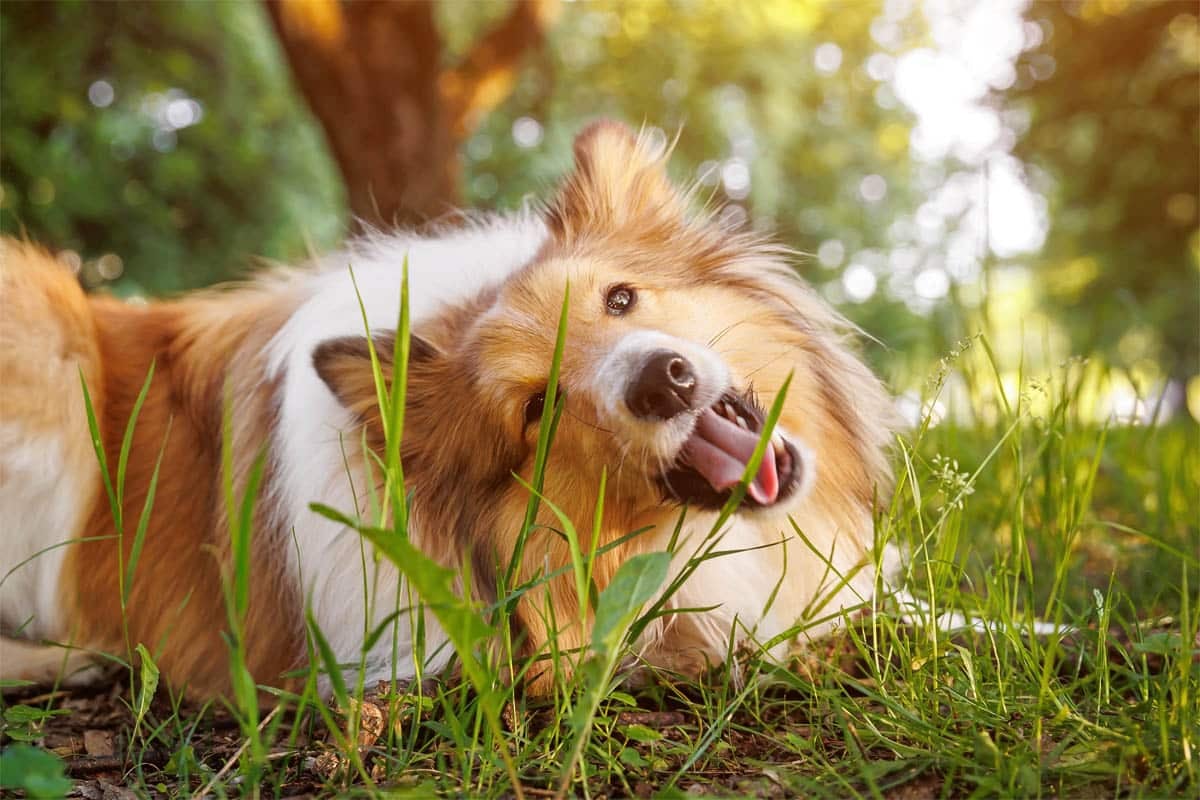
Intestinal parasites are among the concerns dog owners meet regularly. They can be present in the environment and swallowed during a walk, through contact with other animals, or simply when the dog explores his surroundings. Their presence is not always easy to spot, and some dogs show few signs at first.
The digestive system nonetheless deserves particular attention. The gut does not only digest food: it also houses a set of micro-organisms that take part in its balance. This community, known as the gut microbiota, plays an important role in how the digestive system works. Preserving that balance is therefore one of the good habits to adopt in supporting your dog day to day.
It is in this spirit that Vermiflorewas formulated — the ELEMENT VET supplement intended to support a dog's intestinal hygiene. Its formula combines four ingredients: Lactobacillus acidophilus LB, Ceylon cinnamon, diatomaceous earth and pumpkin seeds. Each has different characteristics, and combining them allows several aspects of gut balance to be addressed.

In short: why take an interest in gut balance?
When we think of parasites, we generally think of a wormer. Yet gut health is not simply a matter of whether parasites are present. The gut houses a genuine ecosystem made up of many micro-organisms. When that ecosystem works properly, it takes part in the good working of the digestive system.
That is one reason why the gut microbiota deserves to be taken into account. A suitable diet and good digestive hygiene form the basis, while certain supplements can support that balance. Vermiflore belongs to this approach with a formula combining Lactobacillus acidophilus LB and several ingredients traditionally used to support intestinal hygiene.
Intestinal parasites: what should you know?
Intestinal parasites are organisms that live at their host's expense. In dogs, several types of parasite can be encountered and their consequences are not always the same. Some can cause digestive upset, while others sometimes go unnoticed.
That is precisely what makes monitoring important. A change in the stools, disturbed digestion or an unusual change in the dog's general state may deserve your attention, especially when they persist. These signs should not, however, be automatically put down to parasites: many digestive problems can have other origins. When a parasite is suspected, a stool analysis can help look for its presence.
The vet can then determine whether antiparasitic treatment is needed and which is suited to your dog's situation.
The gut, a genuine ecosystem
To understand the value of a natural approach to intestinal hygiene, you first have to look at what happens in the gut. Billions of micro-organisms live there naturally. Together they form what is known as the gut microbiota.
It can be compared to a small community living inside the digestive system. It includes many different species and its balance can be influenced by diet, by the environment, or by events that disturb digestive functioning.
Caring for that balance therefore does not mean trying to eliminate every micro-organism present in the gut. On the contrary, the aim is to preserve a balanced intestinal environment.

Why does Vermiflore contain Lactobacillus acidophilus LB?
The first ingredient in Vermiflore is Lactobacillus acidophilus LB. This specific strain of lactobacilli is used to support the intestinal environment.*
The idea is simple enough: the gut naturally houses a large quantity of micro-organisms that take part in its balance. In Vermiflore, Lactobacillus acidophilus LB is combined with three other ingredients in order to offer a more complete approach to intestinal hygiene. The microbiota is of course only one part of digestive health. Diet, hydration, physical activity and the dog's general condition also play a role.
The supplement therefore fits within a set of good practices rather than replacing them.
Ceylon cinnamon, a plant long known
Cinnamon is a familiar spice, but its use is not limited to cooking. Certain varieties are traditionally used for their properties, notably in the digestive field.
Vermiflore contains Ceylon cinnamon, chosen to complement the action of the other ingredients in the formula. It is known in particular for its antiseptic and carminative properties and belongs here to an approach supporting intestinal hygiene. Its value takes on its full meaning when combined with the other components of Vermiflore.
The formula does not rest on a single ingredient presented as a miracle solution, but on a combination designed to work on different aspects of digestive balance.
Diatomaceous earth: a lesser-known mineral ingredient
Diatomaceous earth is less familiar to the general public. It is a mineral powder derived from the fossils of tiny aquatic organisms called diatoms. Its particular structure gives it properties that explain its use in various fields.
In Vermiflore, it complements the action of the other ingredients in the formula and takes part in the natural approach offered to support intestinal hygiene.*
As with every component of the product, its use must remain in line with the manufacturer's recommendations. And above all, having a supplement in the dog's routine must not lead to replacing veterinary treatment when a parasite has been identified and requires care.
Pumpkin seeds, a traditional ingredient
Pumpkin seeds have also long been used in natural approaches to gut balance. They contain in particular cucurbitin, a compound naturally present in these seeds.
In Vermiflore, they complete the formula alongside Ceylon cinnamon, diatomaceous earth and Lactobacillus acidophilus LB. The aim is to bring together several ingredients with different properties in a single course intended to support digestive hygiene.
This approach offers a solution that is simple to build into a dog's routine, without forgetting that diet and health monitoring remain the first pillars of his balance.
Why combine these four ingredients?
This is probably the essential point to remember about Vermiflore. Its value lies in the combination of several ingredients rather than in the isolated action of one.
Lactobacillus acidophilus LB works on supporting the intestinal environment. Ceylon cinnamon, diatomaceous earth and pumpkin seeds complete this approach through their respective properties. Together they allow work around the balance and hygiene of the digestive system. This complementarity explains how Vermiflore is formulated.
The aim is not to upset the natural working of the gut, but to support it as part of a well-being routine.
How do you know whether your dog has parasites?
This is a question that cannot always be answered simply by observing your dog. Some parasites can cause digestive signs, but those can also have many other causes.
Unusual stools, repeated digestive upset or a change in general condition should therefore draw your attention, particularly when they last. In some dogs, however, the presence of a parasite can remain discreet. That is why stool analysis can be useful in certain situations.
It allows the presence of parasites to be investigated and gives the vet information that will help choose the right care. Daily observation nonetheless remains essential.
You know your dog's habits better than anyone: his appetite, his stools, his energy and his behaviour are all indicators that let you spot a change.

Can a natural course replace antiparasitic treatment?
It is important to distinguish between a supplement and an antiparasitic medicine. Vermiflore is a supplement intended to support intestinal hygiene. Itmust not be presented as a systematic replacement for veterinary treatment.
When a parasite is identified, the vet can determine the treatment needed according to the parasite concerned and the animal's situation. This care is particularly important for puppies, older or frail dogs, and when a significant infestation is suspected.
A natural approach can therefore have a perfectly good place in a well-being routine, provided it remains complementary and does not delay a consultation when the dog's condition calls for one.
Why do a course four times a year?
For Vermiflore, ELEMENT VET recommends four courses a year. This frequency makes it easy to build the supplement into the dog's annual routine, at different times of the year.
This course obviously does not remove the need for regular monitoring of the animal. On the contrary, it can be an opportunity to take stock of his general condition, his digestive comfort and his habits.
Nor should the frequency of Vermiflore courses be confused with that of a medical antiparasitic treatment. These two approaches do not have the same aim and do not necessarily follow the same calendar.
Puppy, adult, working dog or senior: who is Vermiflore for?
Vermiflore can support the puppy, the adult dog, the working dog and the senior dog. Needs are not, however, identical at every age.
A puppy in full growth, an active adult dog or a senior dog may live in very different environments and have specific nutritional needs. Lifestyle also counts: a dog who works or regularly takes part in a sport may be exposed to different situations from a dog who mainly goes out around his neighbourhood.
The aim is therefore to see Vermiflore as one element of an overall routine, and not as the same answer for every dog. If in doubt, particularly for a puppy or a dog with a health problem, the vet's opinion remains essential.
Vermiflore ELEMENT VET: a natural approach to intestinal hygiene
With Vermiflore, ELEMENT VET chose to combine four complementary ingredients: Lactobacillus acidophilus LB, Ceylon cinnamon, diatomaceous earth and pumpkin seeds.
This formula belongs to a natural approach to intestinal hygiene. Lactobacillus acidophilus LB supports the intestinal environment, while the three other ingredients complete the formula around digestive comfort and balance.
The recommendation is to do four courses a year, alongside a suitable diet and regular monitoring of your dog's condition.
Caring for your dog also means caring for his gut balance.
VERMIFLORE ELEMENT VET
Gut balance, naturally.
Lactobacillus acidophilus LB • Ceylon cinnamon • Diatomaceous earth • Pumpkin seeds
Frequently asked questions about Vermiflore and intestinal parasites
Is Vermiflore a wormer?
Vermiflore is a supplement intended to support a dog's intestinal hygiene. It does not replace an antiparasitic medicine when treatment is necessary and prescribed by your vet.
How many times a year can you do a Vermiflore course?
ELEMENT VET recommends four courses a year. This recommendation concerns the supplement course and does not replace any antiparasitic protocol advised by your vet.
What are the ingredients in Vermiflore?
The formula combines Lactobacillus acidophilus LB, Ceylon cinnamon, diatomaceous earth and pumpkin seeds. These four ingredients were brought together to support different aspects of gut balance.
Why Lactobacillus acidophilus LB in a course intended for intestinal hygiene?
Lactobacillus acidophilus LB is used to support the intestinal environment. It is one of the four complementary ingredients in Vermiflore.
How do I know whether my dog has parasites?
The signs can vary greatly and some dogs show few symptoms. Digestive upset or a persistent change in the stools may justify a consultation. A stool analysis can also help look for the presence of parasites.
Can Vermiflore be given to a puppy?
Vermiflore is presented as able to support dogs at different ages, including puppies. As a young dog's needs are specific, ask your vet's advice to determine whether this course suits his situation.
Gut balance, an attention that runs all year
Your dog's digestive health does not depend on a single action or a single product. It rests on a set of daily habits: a suitable diet, good hygiene, regular monitoring and prompt care when a problem appears.
Intestinal parasites can be among the things to watch, but they are only one of many possible causes of digestive upset. That is why observation remains essential and why an analysis or a veterinary opinion may be needed in case of doubt.
With Vermiflore, ELEMENT VET offers a natural formula combining Lactobacillus acidophilus LB, Ceylon cinnamon, diatomaceous earth and pumpkin seeds, to support the balance and intestinal hygiene of the dog.
A course four times a year, a suitable diet and good daily observation: simple steps to care for your dog, from the inside.
Going further: what does the research say?
Several ingredients in Vermiflore have been the subject of scientific research.
Lactobacillus acidophilus LB
Lactobacillus acidophilus LB has been the subject of experimental and clinical work on the intestinal environment. In vitro work has in particular studied its capacity to limit the adhesion of certain Escherichia coli strains to intestinal cells. Clinical trials have also studied the heat-killed preparation of Lactobacillus acidophilus LB in diarrhoeal disorders in humans.¹ ²
This work documents Lactobacillus acidophilus LB specifically, but does not constitute clinical studies of Vermiflore in dogs.
Diatomaceous earth
Diatomaceous earth has also been the subject of work in various animal species. A study published in Poultry Science examined its use in the feed of free-range hens. In one of the two lines studied, the researchers observed a decrease in certain parasite parameters, notably concerning Capillaria and Heterakis. These effects were not, however, found in the same way in the other line.³
Scientific references
1. Chauvière G., Coconnier M.H., Kernéis S., Darfeuille-Michaud A., Joly B., Servin A.L. (1992). Competitive exclusion of diarrheagenic Escherichia coli (ETEC) from human enterocyte-like Caco-2 cells by heat-killed Lactobacillus. FEMS Microbiology Letters, 70(3), 213-217.
2. Xiao S.D. et al. (2003). Multicenter, randomized, controlled trial of heat-killed Lactobacillus acidophilus LB in patients with chronic diarrhea. Advances in Therapy, 20(5), 253-260.
3. Bennett D.C., Yee A., Rhee Y.J., Cheng K.M. (2011). Effect of diatomaceous earth on parasite load, egg production, and egg quality of free-range organic laying hens. Poultry Science, 90(7), 1416-1426.
This information is general and does not replace personalised veterinary advice. Vermiflore is a supplement and does not replace antiparasitic treatment when that is necessary. In case of doubt, persistent symptoms or an identified parasite, ask your vet's advice.


