

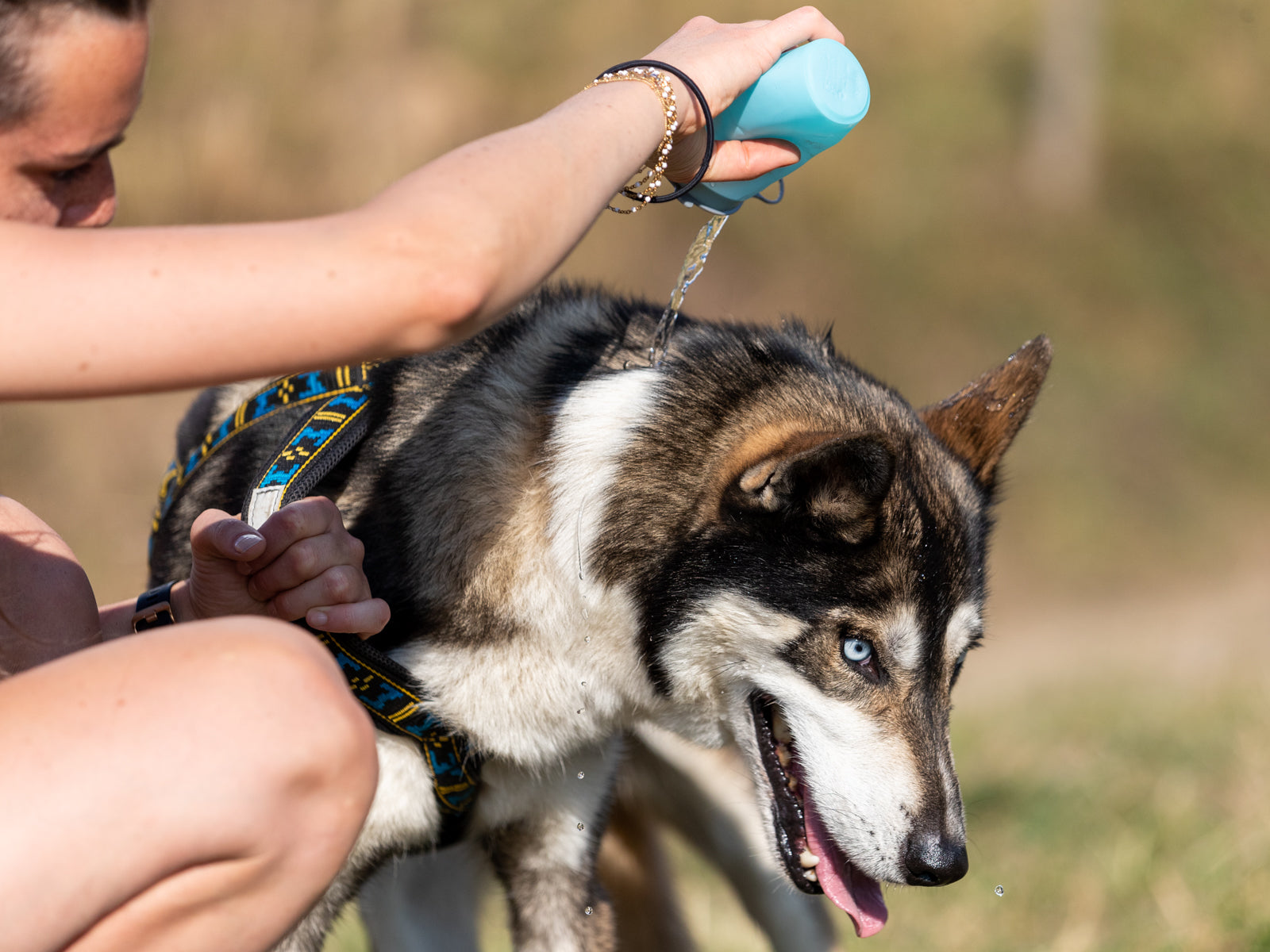
Summer is a season we love to share with our dogs. Forest walks, hikes, holidays, swims... so many precious moments that strengthen our bond.
But when the temperature climbs, our companions become particularly vulnerable. Unlike humans, dogs regulate their body temperature with difficulty. Prolonged exposure to heat can quickly cause dehydration, exhaustion or, in the most serious cases, a heatstroke, a genuine veterinary emergency.
The good news? A few simple habits protect your dog effectively all summer long.
Why do dogs cope less well with heat?
Unlike humans, dogs sweat very little. Their sweat glands are essentially in the paw pads, which is not enough to cool the body effectively.
To release heat they mainly use panting. By breathing rapidly, they encourage the evaporation of moisture in their airways.
This system works up to a certain point. When temperatures become very high or exercise is prolonged, it can quickly be overwhelmed.
Some categories of dog are even more sensitive:
- puppies;
- older dogs;
- sporting dogs;
- overweight dogs;
- brachycephalic breeds (French Bulldog, Pug, Boxer and so on);
- dogs with cardiac or respiratory conditions.
Walk your dog at the coolest hours
During the summer, adapt your walking times.
Favour:
- early morning;
- the evening after sunset;
- wooded or shaded areas.
Between 11 am and 6 pm, keep outings to the strict minimum.
Even if your dog seems keen to run or play, his body may already be struggling.
Watch the paw pads: the ground can burn
In full sun, tarmac can exceed 50 to 60°C, while the outside temperature still feels bearable.
A simple test lets you assess the risk:
Place the back of your hand on the ground for 7 seconds.
If it becomes painful for you, it is painful for your dog too.

Favour:
- grass;
- forest tracks;
- natural paths;
- shaded areas.
Burnt paw pads are a frequent injury during the summer. Our special prevention article.
Teach your dog to take breaks
Excitement often masks the first signs of tiredness.
During activities:
- hiking;
- canicross;
- agility;
- ball games;
- long walks,
do not hesitate to interrupt the effort regularly.

Simple commands such as:
- “Stop”
- “Steady”
- “Wait”
allow the dog to recover before his body temperature rises too far.
The signs that should alert you
Watch your dog closely.
The first symptoms of excessive heat are often:
- very heavy panting;
- a dark red or purplish tongue;
- heavy drooling;
- unusual tiredness;
- slowing down;
- constantly seeking shade;
- refusing to move on;
- difficult recovery after exercise.
If your dog shows:
- vomiting;
- loss of balance;
- disorientation;
- collapse,
consult a vet immediately.
Heatstroke is a life-threatening emergency.
Hydration: your best ally
Water is the first remedy against high heat.
Your dog must always have:
- clean water;
- cool water;
- permanent access.
To encourage a dog who drinks little:
- put out several bowls;
- use a water fountain;
- add a little water to the kibble;
- take a flask on every outing;
- offer small amounts of water regularly.
Ice cubes can also be offered in moderation as a small refreshing treat. Our article
Why do electrolytes matter?
When a dog sweats little but pants a great deal, he loses not only water but also essential electrolytes, which are indispensable to muscle and nerve function.
After:
- a hike;
- a training session;
- a long journey;
- prolonged exposure to heat,
it can be worth supporting his rehydration.
It is with this in mind thatELEMENT VET Rehydration was formulated.
Its composition contributes to maintaining electrolyte balance and supports the recovery of sporting dogs, seniors, or those particularly exposed to high heat.
👉 Combined with good daily hydration, it helps your companion through spells of heat.

Cooling your dog at home
Even indoors, a few simple habits improve his comfort:
- close the shutters during the day;
- create draughts;
- leave access to the coolest rooms;
- use a fan without pointing it directly at him;
- put a damp towel in his resting place.
Are cooling mats effective?
Yes, they can bring real comfort.
Cooling mats allow the dog to release part of his body heat when he lies on them.
Cooling vests are also useful for summer hikes.
They never replace:
- good hydration;
- suitable timing;
- regular breaks.
They simply complete these good practices.
Swimming: an excellent way to cool off
If your walk passes near:
- a river;
- a lake;
- a stream,
let your dog dip his paws or swim if he enjoys it.
Always check:
- the water quality;
- the absence of suspect algae;
- the absence of standing water.
Carry on taking your own supply of drinking water all the same.
Should you clip your dog in summer?
Contrary to received ideas, the answer is generally no.
In double-coated dogs (Golden Retriever, Australian Shepherd, Husky, Samoyed and so on), the undercoat acts as genuine thermal insulation.
Clipping can on the contrary encourage:
- sunburn;
- poorer temperature regulation;
- regrowth problems.
Regular brushing remains the best solution.
Never leave a dog in a car
Even with a window ajar, the temperature in a car can become fatal within minutes.
Every summer, many dogs suffer heatstroke after being left alone in a vehicle.
No quick stop justifies that risk.
A calm summer is prepared in advance
Summer can be a wonderful season to share with your dog, provided you adapt your habits.
By adapting walking times, watching the paw pads, encouraging optimal hydration and respecting his pace, you considerably reduce the risks linked to high temperatures.
At ELEMENT VET, we are convinced that good prevention is the finest gift you can give your companion, so you can enjoy the summer fully while preserving his health, his comfort and his well-being.
Because our mission is simple: to make your animal's life better.

FAQ: the most frequent questions
At what temperature does a dog suffer from heat?
From 25°C, some dogs can show signs of discomfort. Above 30°C, vigilance must be at its highest, particularly for puppies, older dogs and brachycephalic breeds.
How do I know whether my dog is having heatstroke?
Very intense panting, a purplish tongue, sudden tiredness, vomiting or loss of balance are warning signs. Consult a vet immediately.
Should my dog drink more in summer?
Yes. Water needs rise with heat and physical activity. Cool water must be available at all times.
Can paw pads burn on tarmac?
Yes. Tarmac can exceed 60°C in full sun and cause significant burns.
Do sporting dogs have particular needs in summer?
Yes. After exercise they have greater needs for water and electrolytes, to support good recovery and limit the effects of heat.


