

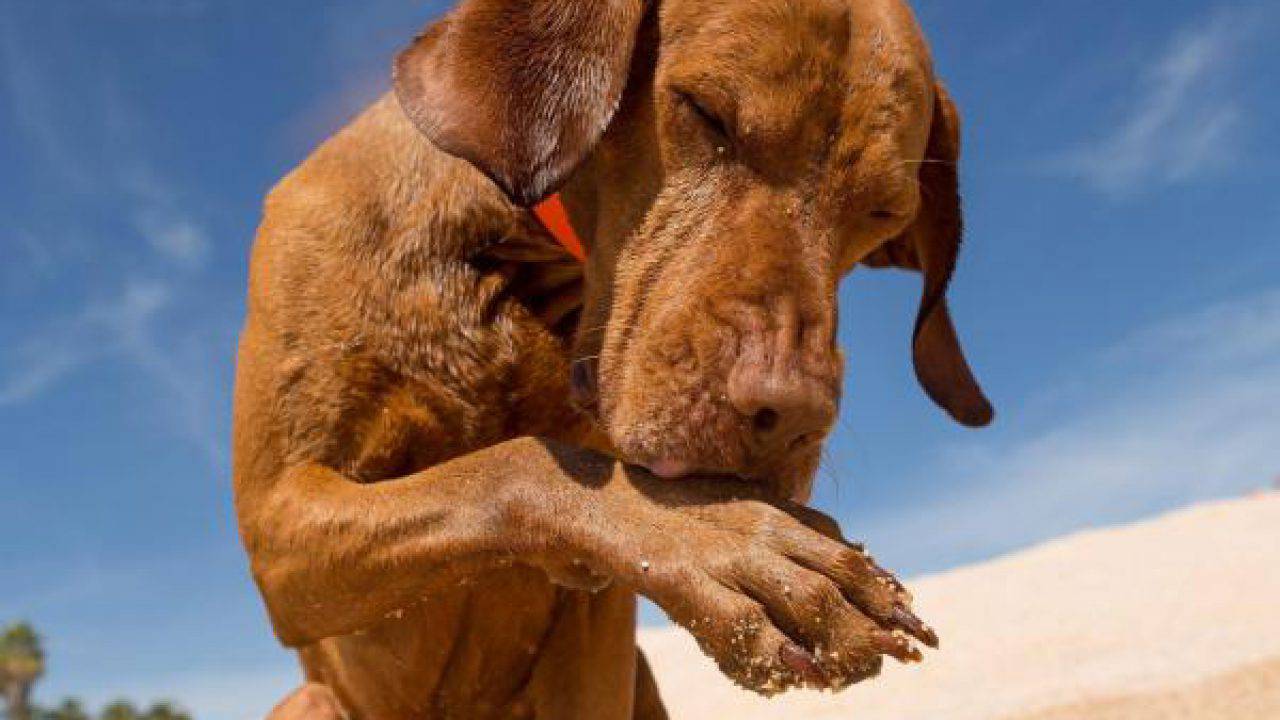
Why does your dog lick his paws?
Seeing your dog lick his paws from time to time is nothing to worry about. Like us, dogs have their little grooming habits, and it is not unusual for them to clean their paws after a walk.
The situation deserves more attention when the licking becomes frequent, very intense, always focused on the same paw, or comes with other signs such as redness, a sore or a limp.
In that case, the behaviour may be a sign of a skin problem, of pain, of irritation, or of a behavioural issue.
Observing when and how your dog licks his paws already gives valuable clues.
In short: a dog may lick his paws simply to clean them. Frequent or sudden licking, on the other hand, may be linked to irritation, an allergy, parasites, a foreign body, pain or stress. Persistent licking, or licking together with redness, a sore or a limp, justifies veterinary advice.

Why does a dog naturally lick his paws?
Dogs lick naturally to maintain their coat and their paws.
After a walk, for example, they may use their tongue to remove a little earth, sand or other small debris left between the toes.
The paw pads are also a particular area in the dog: they have sweat glands, even if sweating plays a limited role in regulating his temperature, which rests mainly on panting. Licking after an outing or after walking in water is therefore generally unremarkable.
What should draw your attention is above all a change of habit : a dog who suddenly starts licking his paws far more often than before is worth looking into.
When should you worry about a dog licking his paws?
There is no precise number of licks beyond which you should worry. Context counts for a great deal.
Occasional licking after a walk does not mean the same as a dog spending several minutes nibbling his paws every day. Likewise, focusing on a single paw is more concerning than grooming spread across all four.
By licking an irritated area repeatedly, the dog can himself maintain the inflammation and create a genuine vicious circle: the skin becomes sensitive, the licking increases, and the irritation worsens.
A pododermatitis, that is, an inflammation of the skin of the paw, can then appear.
A vet will look in particular at three things: how often the licking happens, the area concerned, and any associated signs.
| Type of licking | Observed frequency | Level of vigilance |
|---|---|---|
| Natural grooming | Occasional | Low |
| Repeated licking | Daily | Moderate |
| Very intense licking | Very frequent or hard to interrupt | High |
To remember:
- Occasional licking after an outing: generally normal behaviour
- Licking focused on a single paw: to be watched
-
Very frequent licking with redness, a sore or pain: warning signal
Why does my dog always lick the same paw?
Local pain or irritation can quickly draw a dog's attention to his paw.
A small sore, a cut, a burn, a damaged pad or a foreign body can be enough to trigger repeated licking.
When a dog suddenly starts licking a single paw, a first visual inspection is therefore particularly worthwhile.
It may be something small lodged between the toes, or an irritated area that is not immediately noticeable.
Joint pain can also be involved in some licking behaviour, particularly when chronic pain sustains a lick dermatitis.
Osteoarthritis should not, however, be treated as an automatic cause of a dog licking his paws. It generally comes with other signs: stiffness, difficulty getting up, less willingness to move, or discomfort during certain movements.
Allergies, parasites and foreign bodies: frequent causes to look for
When a dog licks his paws regularly, skin problems are among the first avenues to explore.
Allergies
Allergies are in particular a frequent cause of itching in dogs.
They can be linked to the environment, to certain food components, or to contact with an irritant substance. Red, irritated or thickened skin, or brownish staining of the hair around the paws, can accompany the problem.
In some cases, a secondary infection with bacteria or yeasts also complicates the situation.
Parasites
Parasites are also among the possible causes of itching.
Foreign bodies
A grass seed, a small splinter, a piece of gravel or another foreign body can lodge between the toes and cause very targeted licking, sometimes with a limp.
One small habit can make the difference: after a walk, take a few seconds to look at the pads and the spaces between the toes.
- Inspect the pads and the spaces between the toes
- Spot any redness, cut or swollen area
- Do not try to remove a deeply lodged foreign body
- Consult if the dog limps or the pain seems significant
| Physical cause | Associated signs | What to do? |
| Pain or irritation | Targeted licking, sensitivity, sometimes a limp | Have the paw examined if the problem persists |
| Allergies | Itching, redness, repeated licking | Look for the cause with the vet |
| Parasites | Itching, skin irritation | Check antiparasitic prevention and ask for advice |
| Foreign body | Sudden licking, limp | Consult if it is deeply lodged |
Can a dog lick his paws because of stress or anxiety?
Not every case of licking originates in the skin or the pads. In some dogs, licking can also appear in a context of stress or anxiety.
A house move, a change of habits, an unusual absence, or the arrival of a new person or a new animal in the household can, for example, unsettle some dogs.
Licking may then serve to soothe. The problem arises when the behaviour repeats so much that it ends up sustaining skin irritation itself.
It is therefore worth looking at what happens around the behaviour:
- Does your dog lick more when you leave?
- After a particular event?
- When he stays alone?
- Or for no apparent reason, even when he seems perfectly relaxed?
Can a dog lick his paws out of boredom?
A dog lacking physical activity, exploration or mental stimulation can sometimes develop repetitive behaviour.
Licking can then become an occupation in itself. That does not mean a dog who licks his paws is necessarily “bored”.
Before settling on that hypothesis, it is important to rule out medical causes, notably allergies, parasites, infections and pain.
Context therefore remains essential. A dog who licks after a long period of inactivity is not necessarily sending the same signal as a dog who licks despite a day full of activity.
When does paw licking become compulsive?
In some cases, repetitive behaviour can end up being hard to interrupt. That is what can be seen in certain forms of compulsive behaviour.
Lick dermatitis, for example, can have several origins at once.
Pain or irritation may be the starting point, and the licking then sustains the inflammation. Stress can also play a part in this vicious circle.
It is therefore better not to scold a dog who licks insistently. Punishment does not address the cause and can, in some contexts, add stress to the problem.
Observe instead when the behaviour appears and what happens just before.
- Licking after an unusual situation: explore the stress avenue
- Licking associated with a lack of activity: the boredom avenue
- Very repetitive licking, hard to interrupt: seek veterinary advice
| Behavioural origin | Triggering context | Distinguishing sign |
| Stress, anxiety | Change, absence, novelty | The behaviour appears in an identifiable context |
| Boredom | Lack of stimulation | Other repetitive behaviours may be present |
| Compulsive behaviour | Trigger hard to identify | Repetitive licking, sometimes even in calm moments |
When should you consult a vet about a dog licking his paws?
When the licking becomes frequent, intense, focused on a single paw, or comes with a sore, bleeding, significant redness or a limp, it is best to ask a vet for advice.
This is particularly important when the problem appears suddenly or worsens quickly.
Several causes can produce very similar symptoms, and only an examination can tell the difference between irritation, an allergy, an infection, a parasite, a foreign body or another condition. The sooner the cause is identified, the easier it is to prevent the licking from settling into a genuine vicious circle.
How do you care for your dog's paws day to day?
There is no need to wait for a problem to appear before caring for your dog's paws. After a walk, especially when the ground was muddy, very dusty, salty or particularly irritating, take the time to check the pads and the spaces between the toes.
A simple rinse with clean water, followed by careful drying, can also help remove certain substances present on the paws. Cleaning the feet after an outing can in particular limit exposure to allergens present in the environment.
For long-haired dogs, regularly checking the hair between the toes also makes it easier to spot small debris or foreign bodies.
Good habits:
- Inspect the paws after outings
- Clean the pads when necessary
- Dry well between the toes
- Watch for redness or small lesions appearing
Supplements according to the identified cause
Supplements can have their place in supporting a dog, but they should not be used to mask a symptom whose origin is unknown.
In case of a joint problem, certain nutraceuticals may be offered alongside veterinary care.
The scientific data on glucosamine and chondroitin nonetheless remains nuanced: WSAVA recommendations mention possible but variable effects, while the available data do not allow these substances to be considered a treatment on their own.
For dogs prone to stress, certain ingredients may also be offered alongside whole-picture care.
A targeted anti-stress supplement is not on its own a solution to a behavioural problem.
ELEMENT VET, a site designed by a vet, offers a selection of supplements and care products intended to support dogs day to day.
For a senior dog or one with joint sensitivity, see in particular the selection dedicated to joint support.
This information remains general and does not replace personalised veterinary advice. Before starting a course or using a supplement, ask a professional for advice in order to choose a solution suited to your dog and his situation.
What response for which identified cause?
- Inspect the paws after every outing
- Seek veterinary advice if the licking becomes repetitive
- Choose a supplement according to the identified need
| Identified cause | Possible response |
| Joint problem | Suitable care, possibly completed by a nutraceutical |
| Stress, anxiety | Identify the triggers and put suitable support in place |
| Allergy, infection | Targeted veterinary treatment |
| Foreign body | Suitable removal and care of the area |
A dog licking his paws: a signal to watch over time
A dog who licks his paws does not necessarily have a problem. A few licks after a walk are simply part of his habits. It is when the behaviour changes that it becomes worth paying attention.
One paw always targeted, licking that lasts, redness, a sore or a limp are all small signals that deserve your attention.
Allergy, irritation, parasite, foreign body, pain or stress: the causes can be very different and sometimes combine.
The aim is therefore not to look immediately for a single explanation, but to observe your dog, to look at his paws regularly, and to consult when something seems unusual. Day to day, this simple attention often makes it possible to spot a change sooner and, above all, to stop a small problem from becoming a larger one.
Frequently asked questions about paw licking in dogs
Why does my dog lick his paws non-stop?
Frequent licking can have various origins: irritation, allergy, parasites, infection, a foreign body, pain or stress. When the behaviour becomes repetitive or intense, it is best to look for the cause with a vet.
Why does my dog always lick the same paw?
Sudden licking targeted on a single paw may be linked to irritation, a small injury, a damaged pad or a foreign body. Inspect the paw and the spaces between the toes, and consult if the licking persists, if the dog seems in pain, or if he limps.
Can an allergy make a dog lick his paws?
Yes. Allergies are among the possible causes of itching in dogs. The licking may be accompanied by redness, irritation, or a change in the appearance of the skin or coat.
Can stress cause paw licking?
In some dogs, licking can appear in a context of stress or anxiety and serve to soothe. It is important, however, to rule out a medical origin first.
When should you consult a vet?
Ask a vet for advice when the licking becomes frequent or intense, appears suddenly, always concerns the same paw, or comes with significant redness, a sore, bleeding, pain or a limp.


