

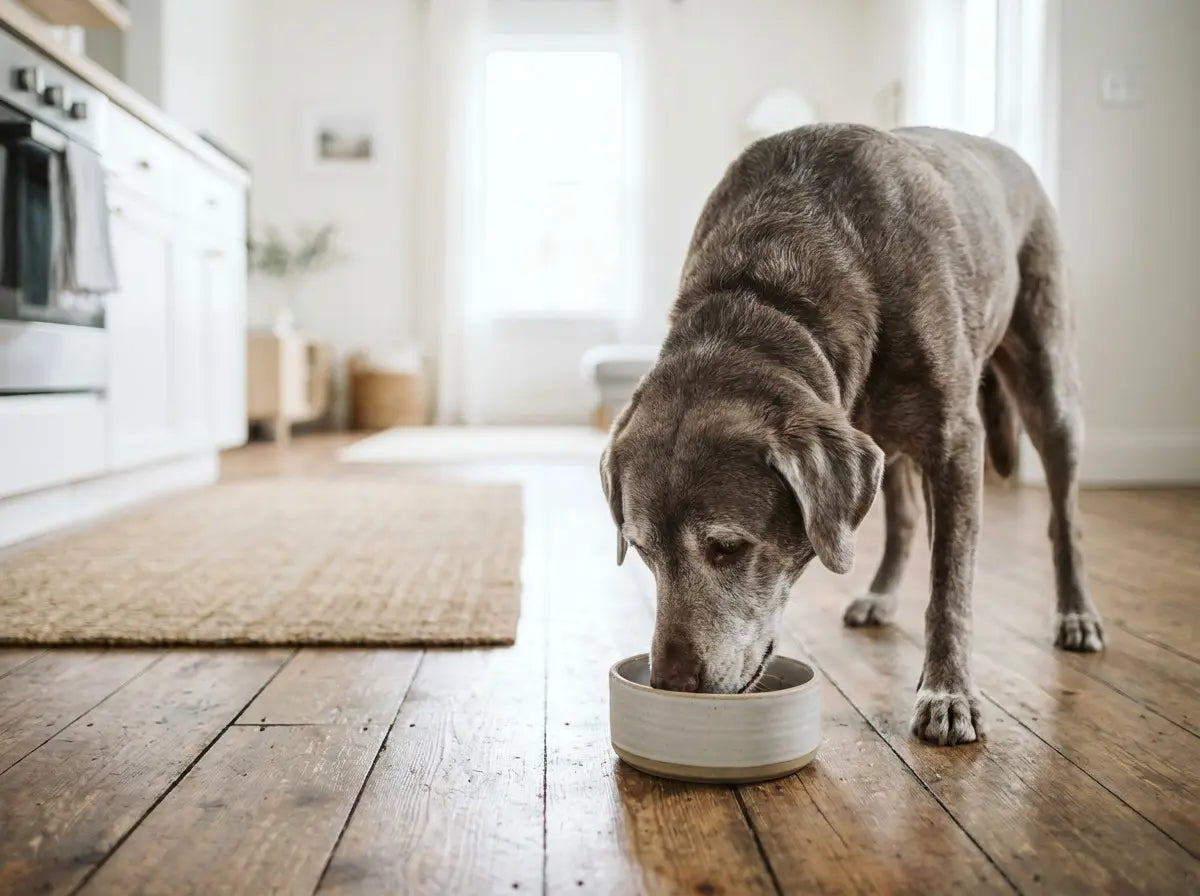
When the temperature climbs, not all dogs experience heat in the same way.
A healthy adult dog will generally adapt his activity spontaneously: he sleeps more, seeks out cool places and reduces his movement during the hottest hours.
For a puppy or an older dog, it is a little different. Their bodies are under greater demand and they can find it harder to cope with strong heat. Their diet, hydration, activity and recovery therefore deserve particular attention during hot spells.
Why are puppies more sensitive to heat?
A puppy is not simply a small adult dog.
His body is still being built. He is developing his muscles, his skeleton, his nervous system and his immune defences. That growth takes a great deal of energy.
And there is another small problem: a puppy is not always aware of his limits.
He can run, play and explore for long minutes without seeming tired… until the moment heat adds a further strain. A walk that would have been perfectly reasonable at 18°C can therefore become far more taxing at 30°C.
During hot spells it is better to favour short, quiet outings at the coolest hours, rather than trying to tire your puppy out as on an ordinary day.

The energy needs of a growing puppy
Growth is a particularly demanding period for the body.
A puppy's energy needs vary with his age, his weight, his breed, his expected adult weight and his activity level. There is therefore no single calorie figure valid for every puppy. Veterinary recommendations use in particular the resting energy requirement, known as RER, to arrive at an estimate.
In a healthy puppy under 4 months, the maintenance energy requirement can be estimated at around 3 times RER. After 4 months, it sits at around 2 times RER. These figures remain starting points that must be adapted to the individual dog and how he develops.
Example for a 20 kg puppy
For a 20 kg puppy, RER is about 660 kcal per day. A puppy over 4 months could therefore have an energy requirement of around 1,320 kcal per day.
This obviously does not mean that every 20 kg puppy should receive exactly that amount. Their growth and activity must be monitored regularly, in particular to avoid putting on weight too fast.
| Profile | Indicative energy requirement |
|---|---|
| Puppy under 4 months | ≈ 3 × RER |
| Puppy over 4 months | ≈ 2 × RER |
| Adult dog | ≈ 1.4 to 1.8 × RER depending on profile |
And when it is hot, the aim is certainly not to increase activity to “burn off” that energy.
On the contrary: let the puppy sleep, recover and play quietly, avoiding intense effort during the hottest hours.
When it is hot, water needs rise
Water is the first thing to watch when it is hot.
In a thermally neutral environment, a dog's needs are generally estimated at around 44 to 66 ml of water per kilo of body weight per day. This estimate varies with diet, activity and environment.
For a 20 kg dog, that means about 880 ml to 1.3 litres of water a day in usual conditions. But this figure must certainly not be turned into a rigid rule.
When it is hot, when the dog pants more or takes physical exercise, his needs can rise. A dog fed mainly on wet food will in any case not drink the same amount as one fed exclusively on dry food.

The good rule therefore remains far simpler: clean, cool water must be available at all times.
| 20 kg dog | Indicative need |
| Usual conditions | ≈ 880 ml to 1.3 L/day |
| High heat | Potentially higher needs |
| Heat + activity | Needs higher still |
There is no universal percentage that says a dog must drink exactly 20, 30 or 40% more when it is hot. What counts is letting him drink freely and staying alert to any unusual change in behaviour.
Why can electrolytes matter when it is hot?
When we think of hydration, we naturally think of water.
And that is indeed the priority.
But the body does not manage a volume of liquid alone. Electrolytes, notably sodium and potassium, take part in the normal working of muscles and the nervous system.
When a dog pants a great deal, makes an effort or recovers after physical activity, water and electrolyte balance can come under greater demand. This does not mean that a dog resting quietly in a cool house needs electrolytes every summer day.
They can, however, be of interest in certain situations: high heat, physical activity, recovery after exercise, or a particularly tired dog.
Rehydration ELEMENT VET : support when needs rise
That is precisely the purpose of ELEMENT VET Rehydration.
This powder, to be diluted in water, is formulated to support rehydration and restore water and electrolyte balance. It supplies soluble electrolytes such as sodium and potassium.
ELEMENT VET recommends it in particular after exercise, during hot spells, or to support a tired or senior animal.
ELEMENT VET Rehydration is not meant to replace water day to day. It complements hydration in situations where needs are greater.
Puppies and heat: good daily habits
With a puppy, anticipating is better than noticing he is already exhausted.
Hot days simply call for a slight review of habits. A walk early in the morning, a few quiet games indoors and an outing in the evening will often suit better than a long walk in the middle of the afternoon.
A few simple habits
- Go out early in the morning or in the evening
- Avoid intense effort during the hottest hours
- Leave cool water available at all times
- Take water on outings
- Plan regular breaks in the shade
- Avoid burning hot ground
- Let the puppy sleep as much as he needs
- Never leave a dog in a car, even for a few minutes
A puppy who becomes unusually weak or disoriented, who vomits, has difficulty breathing or collapses after exposure to heat must be taken seriously: heatstroke is a veterinary emergency.
And what about the older dog?
With age, a dog changes.
He may be less active, recover more slowly after exercise and find it harder to regulate his temperature. Some older dogs may also drink less spontaneously, even though their water needs remain significant.
Heat can therefore add to tiredness that is already there.
In a senior dog, a 30-minute walk that was once a formality can become far more tiring when it is very hot. It is therefore worth thinking in terms of comfort and recovery, rather than kilometres covered.
An older dog may want to go out, sniff and enjoy his surroundings without needing a long hike.

The senior dog also needs to preserve his energy
An older dog does not necessarily spend more energy than a young one. On the contrary, his metabolism and activity level may decrease with age.
But that does not mean you should try to stimulate him more when it is hot.
The point is rather to preserve his reserves and allow him to recover properly. A suitable diet, a stable weight, sufficient hydration and regular but reasonable activity all contribute to his everyday comfort.
And during a hot spell, a few days with more rest are absolutely not a problem.
Why do electrolytes also deserve particular attention in the senior dog?
In the older dog, hydration deserves particular watching.
Some seniors drink less spontaneously, while certain illnesses or treatments can change their water needs. An unusual drop in water intake or, conversely, a significant increase should always be reported to the vet.
In certain situations, notably during high heat or after exercise, supporting rehydration can therefore be of interest.
Rehydration ELEMENT VET can be used in this context to support rehydration and water and electrolyte balance. The brand recommends it in particular for senior, tired or recovering dogs.
Here again, it is not a matter of replacing water or of treating any illness. If an older dog seems particularly weak, refuses to drink or shows an unusual change, the vet's opinion remains indispensable.
Vitality ELEMENT VET: supporting the older dog through difficult periods
Summer can also be a time when you notice a small dip in form in your senior dog.
He sleeps more, seems less lively, recovers more slowly after a walk, or simply needs more time to regain his energy. It is in this context that Vitality ELEMENT VET can find its place in a supportive routine.
The formula combines in particular ginseng, ginkgo biloba, bilberry, echinacea and vitamins. ELEMENT VET intends it in particular for older animals, periods of convalescence, growth and periods of intense effort.
For a senior dog, Vitality can therefore be considered as a supportive course when he is going through a period in which you wish to support his vitality. And when hot weather sets in, this attention to general form makes even more sense.
Heat, age and activity: above all, learn to observe your dog
There is no magic figure that tells you whether a dog copes well with heat.
Two dogs of the same age and weight can react very differently.
One will happily carry on his walk while the other quickly seeks shade. A puppy may want to play without stopping even though he is already very out of breath. An older dog may, on the contrary, show very few signs even though the heat is demanding a great deal of him.
That is why observation remains essential.
| Situation | What to watch |
| Puppy | Excitement, tiredness, panting, ability to recover |
| Older dog | Drop in energy, recovery, willingness to drink |
| High heat | Heavy panting, unusual tiredness |
| Physical activity | Hydration before, during and after exercise |

Good habits for supporting your dog during a hot spell
In the end, protecting a puppy or an older dog during the summer does not take a great deal.
It is mainly about adapting habits:
- Cool water available at all times
- Outings at the coolest hours
- Activity suited to the dog's capacities
- Regular breaks
- Closer watching of puppies and seniors
- Particular attention to recovery after exercise
- Support for rehydration when the situation justifies it
For periods when needs are greater, ELEMENT VET offers suitable complementary solutions: Rehydration, to support hydration and water and electrolyte balance, and Vitality, to support vitality, particularly in the older dog.
Puppy or older dog: summer simply calls for a little more attention
High heat does not mean a puppy must stay shut indoors or that an older dog should no longer go out. You simply have to learn to adapt the pace.
For a puppy, that means respecting a growth that already takes a great deal of energy, and avoiding excessive effort when it is hot.
For an older dog, it means paying attention to his hydration, his recovery and any dips in form.
In both cases, water remains the priority. And when conditions become more demanding, suitable support can help manage these periods better.
Because in summer the best indicator is often the simplest: look at your dog, listen to him and give him time to recover.
To remember: this information is general and does not replace veterinary advice. In case of significant weakness, vomiting, balance problems, breathing difficulty or suspected heatstroke, contact a vet promptly. Supplements do not replace medical care and must be used in line with the manufacturer's recommendations and, where necessary, after professional advice.


